
Admissions · 15 min read
Medicine entry requirements in Spain, university by university
Almost everything written about getting into Medicine treats Spain as a single system. It is not. There are thirty eight public faculties spread across seventeen autonomous regions, and the region you choose changes the mark you need, the calendar, the language of your classes and what you will pay.
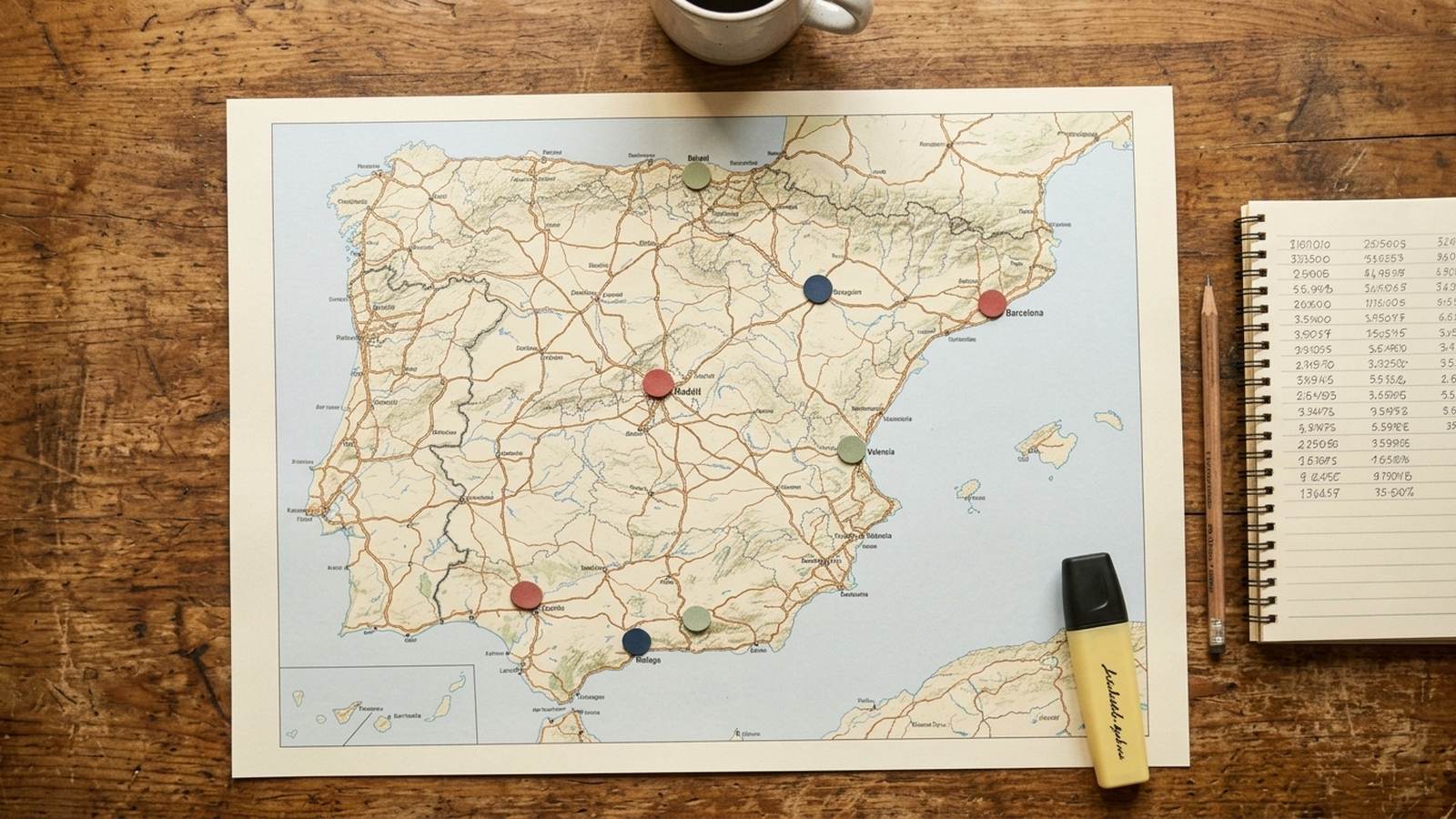
Every week someone asks me what the cutoff mark for Medicine in Spain is, as if there were one. And every week the answer starts the same way: it depends where. Not as a way of dodging the question, but because the gap between one faculty and another can be more than a point, and one point out of fourteen is a great deal.
This article is the map I would have liked to have: what is common to all of them, what changes by region, and how to use those differences in your favour rather than discovering them when it is too late.
The map: thirty eight faculties, seventeen systems
Spain has thirty eight public universities offering the Medicine degree. They are spread across the seventeen autonomous regions, and each region organises in its own way three things that affect you directly: the preregistration process, the subject weightings and the tuition price.
Some universities also have several campuses or teaching units attached to different hospitals, and each can have its own cutoff mark. When someone tells you the University of Barcelona asks for a certain mark, the right question is: at which campus?
The practical consequence is that there is no single Medicine cutoff mark in Spain. There are thirty or so, each with its own history, and the strategy lies in knowing how to read them.
What they all ask for
Before the differences, here is what is the same at every public faculty for a student coming from an education system outside the European Union.
- The UNEDasiss accreditation with an admission grade, which converts your school certificate to the Spanish scale and gives you up to ten points. Without it you cannot take part in preregistration.
- The admission mark out of fourteen, which adds to those ten points what your best PCE subjects contribute multiplied by their weighting. It is the figure you compete with.
- Preregistration on time in each region's system, ranking your preferences.
- Documentation in order to complete enrolment if you get a place, including, if you need it, the study stay permit.
At most universities, a student with UNEDasiss accreditation competes in the general quota with the same mark out of fourteen as a Spanish student. There is no separate exam and no special route: the door is the same, which is why the mark decides everything.
Indicative cutoff marks for the main faculties
These are the cutoff marks published for 2025/26 at some of the most demanded faculties. They are indicative: they change every year, they can fall by a few tenths in later rounds, and they should always be confirmed on each university's website.
| University | Region | Cutoff 2025/26 |
|---|---|---|
| University of Seville | Andalusia | 13.386 |
| University of Granada | Andalusia | 13.347 |
| University of Valencia | Valencian Community | 13.202 |
| Complutense University | Madrid | 13.100 |
| Autonomous University of Madrid | Madrid | 12.978 |
| University of Barcelona, Clínic campus | Catalonia | 12.946 |
| University of Barcelona, Bellvitge campus | Catalonia | 12.760 |
| Autonomous University of Barcelona | Catalonia | 12.586 |
To complete the picture: in the previous year the highest mark in the country was Seville's, at 13.45, and the lowest was the University of the Basque Country's, at 12.33. The average across all public faculties was around 12.96.
What this table says, read calmly, is that the real range between the most demanding faculty and the most accessible one is a little over a point. It looks small. Out of fourteen, with the PCE adding at most four, it is the difference between getting in and staying out.
How to read a cutoff mark without fooling yourself
The cutoff mark is the mark of the last student who got a place in the general quota that year. It is not a requirement the university sets in advance: it is the result of how many places there were and how many candidates with what marks applied for them.
That has three consequences worth being clear about.
It moves every year. If a faculty had a year with few applications, its mark falls, and the following year many people apply precisely because of that and the mark rises. Reading one year is reading a snapshot; reading three is reading the trend.
It falls in later rounds. The mark published in the first allocation is not the final one. When admitted students who had a better option withdraw, the next ones come in, and the final mark can end up a few tenths lower.
It is not a pass mark. Beating last year's cutoff guarantees you nothing this year. Falling a few tenths short does not rule you out either. That is why preference lists are built with margins, not with an exact figure.
And one more precaution: the cutoff marks circulating on websites and forums do not always distinguish between campuses, quotas or rounds, and it is common to find two different figures for the same faculty. When that happens, the source that counts is always the university itself or its region's preregistration platform, not the aggregator that copied it.
Want to know which faculties are within reach with your mark? Tell me your UNEDasiss accreditation and your PCE subjects and we will work out your realistic list together.
Message on WhatsAppWhat changes by region
Each autonomous region runs its own preregistration, with its own calendar, platform and rules. Some work as a single district, so one application lets you request a place at all their universities in order of preference. Andalusia is the best known example.
But you cannot apply for a place across all of Spain with one application. If you want to try for Madrid, Andalusia and Catalonia, you need three separate preregistrations, on three separate platforms, within three deadlines that do not exactly coincide. It is one of the points where international students lose the most options: they know one deadline and assume it applies everywhere.
Weightings also change from region to region, and sometimes between universities in the same region. I explain it in depth in which PCE subjects to choose for Medicine, but the key idea is this: your mark out of fourteen may not be the same at two universities, because the same subject can be weighted differently at each.
The language of your classes
This is the factor almost nobody mentions to an Arab student, and it can decide your first years.
Spain has several official languages, and universities in regions with their own language teach part of the degree in it. In Catalonia, some subjects are taught in Catalan. In the Valencian Community, in Valencian. In the Basque Country there are groups in Basque, and in Galicia teaching in Galician.
That does not mean you cannot study there. In most cases there is teaching in Spanish, exams can be answered in Spanish, and there are groups or tracks in that language. But it does mean you need to check each faculty's language plan before putting it on your list, especially if you are still consolidating your Spanish.
If your Spanish is still intermediate, starting Medicine at a faculty where a third language also appears adds difficulty to a first year that is already demanding. It is not impossible, but it has to be decided knowingly.
Price: this is where being non EU really matters
At Spanish public universities tuition is set by each autonomous region, and the differences are large. For a Spanish or European Union student, a year of Medicine can cost from about 760 euros in Andalusia to over 1,280 euros in Navarre, in tuition alone.
For a student from outside the European Union the difference multiplies, because several regions apply a surcharge to non resident foreign students.
| Region | What a non resident non EU student pays |
|---|---|
| Andalusia | The same public fees as any other student |
| Madrid | The fourth enrolment price, far above the ordinary one |
| Other regions | Variable surcharges, in some cases double the public fee |
And there is a nuance worth underlining: a study stay authorisation does not count as residence. With a student visa, for fee purposes, you are non resident. Students commonly discover this surcharge at the moment of paying tuition, when there is no longer any room to change university.
That is why, all else being equal academically, an Andalusian faculty can cost you a fraction over six years of what a Madrid one would. It is no small matter, and it should enter the decision from the start.
A concrete case: the University of Barcelona
I choose it because it is one of the searches that reaches me most, and because it brings together almost everything explained above in a single case.
- It has two campuses with their own mark. Hospital Clínic, in Barcelona, and Bellvitge, in L'Hospitalet de Llobregat. In 2025/26 their marks were 12.946 and 12.760. Applying to the University of Barcelona without specifying the campus makes no sense: they are two different options.
- Preregistration is Catalonia's. It is done on the Generalitat's platform, with its own calendar, different from Madrid's or Andalusia's.
- Part of the teaching is in Catalan. It is worth checking the degree's language plan before applying.
- The price for non resident non EU students carries a surcharge, as in other regions. It has to be confirmed on the university's website for the specific year.
It is an excellent faculty with a mark somewhat more accessible than Seville or Granada. But before putting it first on your list, those four points need to be resolved.
The opposite case: Andalusia
If Barcelona is the example of a faculty with a somewhat more accessible mark but with language and price complicating things, Andalusia is exactly the opposite.
- It has the highest cutoff marks in the country. Seville and Granada head the table, and other Andalusian faculties are not far behind.
- It works as a single district. With one preregistration you request a place at every Andalusian faculty, in order of preference.
- Teaching is in Spanish. There is no second official language adding difficulty.
- International students pay the same public fees as any other student, which are also among the lowest in Spain.
For an Arab student with a very high mark, Andalusia is probably the most favourable combination in the whole country. For one with a borderline mark, it is the hardest to get into. That is why the same region can be first on one list and absent from another.
The year, from start to finish
Exact dates change every year and each region publishes its own, but the sequence is always the same, and it is worth having it in front of you from the start.
| Stage | What to do |
|---|---|
| Autumn and winter | Gather and legalise documents, apply for the UNEDasiss accreditation |
| Spring | First PCE exam session |
| Early summer | Second PCE session and preregistration opens |
| Summer | Preregistration in each region, first allocations and later rounds |
| End of summer | Enrolment and, if needed, the student visa |
What gets most complicated is the end: preregistration, allocations and the visa are concentrated in a few weeks. Anyone who reaches that point with half finished paperwork loses options that, on paper, their mark entitled them to.
How to build your list of universities
With all of the above on the table, this is how I would build a preference list for a student coming from abroad.
- Work out your mark out of fourteen using each university's weightings, not a general average. It may come out different at each.
- Sort the faculties into three groups: those clearly above your mark, those within your range and those clearly below.
- Filter by language and price. Drop those that do not fit your level of Spanish or your family's budget, even if the mark allows it.
- Build a list of four to eight options, mixing one ambitious choice, several realistic ones and at least one safe one.
- Submit preregistration in each region within its own deadline, with its own order of preferences.
A note on order: in preregistration, the order of your preferences does not penalise you. If you put an ambitious faculty first and do not get in, you move to the next one without losing anything. That is why it makes sense to start the list at the top, as long as the bottom of the list is well secured.
A well built list is not the one with the most prestigious universities, but the one that leaves you with a place in September.
The mistakes that cost the most places
- Applying to a single university. The quickest way to lose a year.
- Using one mark for all of them. With different weightings, your mark changes from one faculty to another.
- Assuming all deadlines are the same. Each region has its own.
- Not checking the teaching language. And discovering it in the first week of class.
- Not asking about the non EU price. And discovering it when paying tuition.
- Reading only one year. Three years of cutoff marks say far more than one.
Frequently asked questions
How many public universities offer Medicine in Spain?
Thirty eight public universities offer the Medicine degree, spread across the seventeen autonomous regions. Some have several campuses with their own cutoff mark.
What are the highest and lowest Medicine cutoff marks?
In recent years the highest has been around 13.4 out of 14, at the University of Seville, and the lowest around 12.3, at the University of the Basque Country. The average is close to 13.
Do international students compete for the same places?
At most universities, a student with UNEDasiss accreditation competes in the general quota with their admission mark out of 14, exactly like a Spanish student.
Do non EU students pay the same at public universities?
It depends on the region. Andalusia applies the same fees to all students, whereas Madrid charges non resident non EU students the fourth enrolment price. A study stay permit does not count as residence.
What language is Medicine taught in in Catalonia or Valencia?
At Catalan and Valencian universities part of the teaching is in Catalan or Valencian as well as Spanish. In the Basque Country and Galicia there is also teaching in Basque and Galician. It is worth checking each faculty's language plan.
Let us build your list with real numbers
Tell me your UNEDasiss accreditation, your PCE subjects, your level of Spanish and your family's budget, and we will come out with a list of faculties that leaves you with a place.
Message on WhatsAppIf you have not yet worked out your mark out of fourteen, start with how cutoff marks are calculated. And if the public route looks out of reach, see how private universities work.
Published on 26 September 2026 · Salam Aiach